What If Every AI Shut Off for 24 Hours? An Hour-by-Hour Thought Experiment
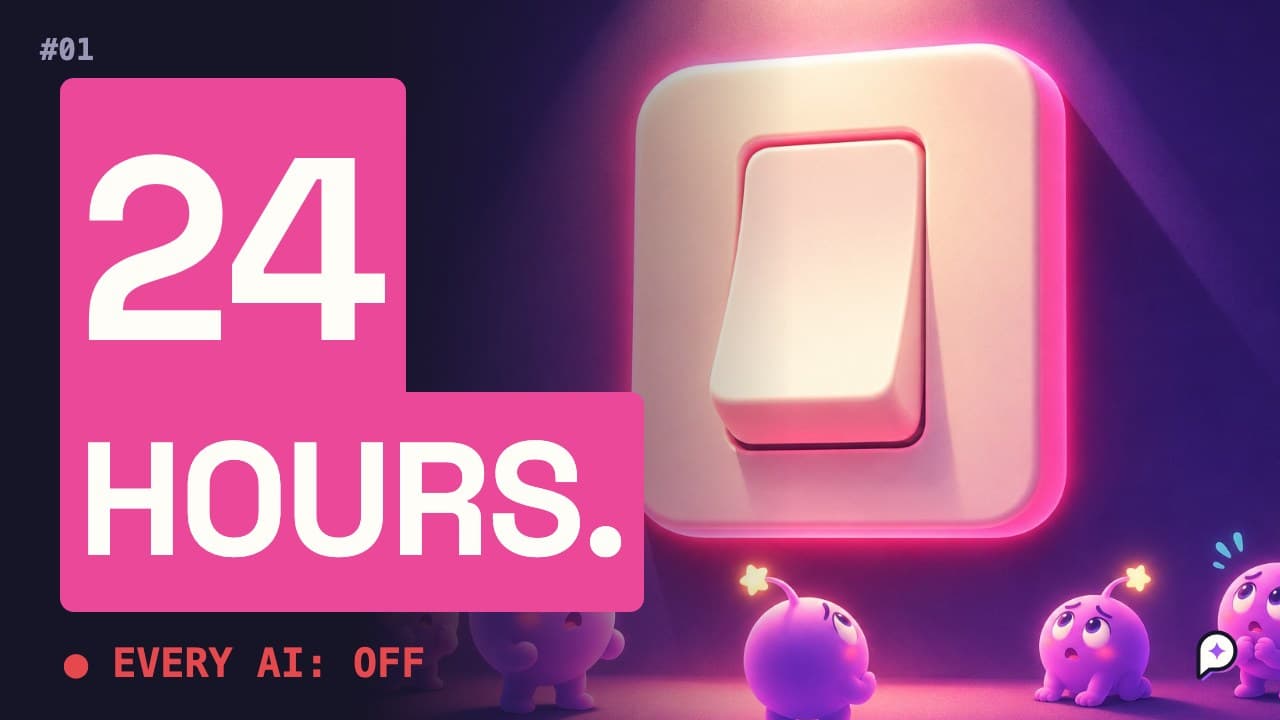
At 9 a.m. tomorrow, every AI system on Earth switches off.
That means more than the chatbots. The systems that stop fraud on your card switch off too, along with the ones that filter your inbox and the ones that choose what you watch next.
For the first hour, you barely notice. By lunchtime, your phone, your bank and your inbox are all acting a little strange. By the next morning, we've learned something about the world that almost nobody thinks about.
This is the first of our Pretend Experiments: we pretend something big happens, then watch it play out hour by hour. Every number below has a public source, listed at the end.
The rules of the experiment
- Every machine-learning model stops. Chatbots, recommendation engines, fraud scorers, the face unlock in your pocket.
- Normal software keeps running. Code that follows fixed rules ("if this, then that") still works.
- Electricity, physics and people stay. The grid is up, and humans are still at their desks.
- 24 hours, then it all comes back.
That last rule matters. The honest answer to this question is not "the world ends". It's stranger than that.
Hour 0: the first thing you notice is your phone
Face unlock runs on a small AI model inside the phone. With it gone, you type your passcode like it's 2012.
You open a chatbot and get no reply. Voice typing doesn't understand you either. The camera still takes photos, but the processing that makes night shots look bright is gone, so they come out flat and noisy.
None of this is a disaster, just annoying, and annoying is the theme of the first hour.
Translation goes quiet
Google says its translation tools (Translate, Search and Lens) handle around a trillion words a month for more than a billion people. A doctor reading a note in another language, a traveller at a train station, a small shop answering a customer abroad: all of them are suddenly on their own.
Live captions stop, and so do the automatic image descriptions that blind users rely on. Many screen readers can keep going with their basic built-in voices. But the world gets harder to understand, and it gets harder fastest for the people who already had the least help.
Hour 1: your feed forgets you
Netflix has said its recommendations influence about 80% of what people watch. YouTube once said about 70% of watch time came from its suggestions. Those figures are from 2015 and 2018, but the point still holds.
The apps don't go dark. They just stop guessing. You get a plain list sorted newest first, or a search box.
For one strange day, you have to decide what you want, not the algorithm.
Hour 2: the invisible guard at the checkout
You buy a coffee with your card, and it works. But something invisible just changed.
Most card payments today get checked by an AI in a few milliseconds and given a risk score. At Visa, that score typically runs from 0 to 99. Mastercard says its system scores 143 billion transactions a year.
Today, that score is missing, and banks fall back on older rule systems:
| With the AI score | Without it: old rules come back |
|---|---|
| Learns your habits ("books on Sundays") | Blunt spending limits |
| Flags new kinds of fraud | Location checks |
| Rarely blocks honest buyers | More PINs and one-time codes |
| More "declined" for honest people |
Rules are blunt. So honest people get declined more, and clever fraud that looks normal slips through more. Visa has said one of its AI fraud tools helped prevent an estimated $33 billion of fraud in 2023. Even one day without it is a gift to fraudsters.
Hour 6: the inbox floods
Google says Gmail's machine-learning filters block more than 99% of spam and phishing. That's why you rarely see any of it.
Older filters and blocklists still exist, so not everything gets through. What's gone is the part that spots a brand-new scam it has never seen before.
This is where the day gets more serious, because security teams work the same way. Their AI watches networks for strange behaviour. With it switched off, an attacker who tries something new today has a better chance than usual.
Hour 9: the grid gets nervous
Power grids have to match supply and demand every second. With more solar and wind, they need to know how sunny and windy the next few hours will be. Britain's grid operator said machine learning had improved its solar forecasts by about a third.
Without it, the forecast gets blurrier. Operators would most likely keep more backup power ready, often gas plants, just in case.
The lights stay on, because people and spare capacity cover the gap. But it costs more and burns more fuel.
Hour 12: slower, not stopped
By hour twelve the pattern is clear: things don't stop, they slow down.
- Maps still give you a route, but arrival times are less precise. DeepMind said in 2020 that its model cut arrival-time errors by up to 50% in some cities.
- Deliveries get routed the old way.
- Hospitals: more than a thousand AI tools have been cleared in the United States, most of them for reading scans. They work like a second pair of eyes and push urgent cases to the top of the pile. Today, doctors read every scan themselves, as they did for decades. The work still gets done; the queue just gets longer.
Wait. What about weather, planes and markets?
This is where most takes on this topic get it wrong.
- Weather forecasts don't stop. The main forecasts are built on physics and run on supercomputers. AI forecast models now run alongside them and are very good, so you lose an extra opinion, not the forecast.
- Planes don't fall out of the sky. People run air traffic control, using radar and rules; AI tools only advise. Autopilots are classic control engineering, not machine learning.
- Stock markets don't crash on their own. Much automated trading follows fixed rules, not machine learning. Some AI-driven strategies would pause and prices might move, but the market opens.
The real pattern: ten thousand invisible helpers
We imagine AI as one big brain, a single thing you could switch off. It isn't. It's thousands of small helpers hidden inside things we already use, and each one makes something a little faster, a little cheaper or a little more accurate.
Switch them all off and nothing explodes. Everything just gets a little worse, at the same time, everywhere.
Hour 18: what gets better?
Here's the twist: some things improve.
- No new deepfakes are being made, and no new wave of AI-written spam floods the internet. The old ones are still out there, but the factory has stopped for a day.
- A sliver of energy is saved. Data centres use around 1.5% of the world's electricity, according to the International Energy Agency. Only part of that is AI, so one day off saves a sliver, but not nothing.
- People choose for themselves. Millions pick what to read, watch and listen to on their own, and some of them find something they would never have been shown.
This has almost happened
If this sounds far-fetched, we've already lived through small versions of it. None of these were AI failures. Each was one point that everything depended on:
- 2021: Facebook, Instagram and WhatsApp went down for about six hours because of one bad configuration change.
- 2024: a single faulty software update crashed about 8.5 million Windows computers. Flights were cancelled, and hospitals and banks scrambled.
- A UK government study estimated that an unexpected one-day loss of GPS could cost Britain about £1.4 billion.
The real question
In every one of those stories, a huge number of things depended on one single point. When that point failed, everything failed together.
That's the real lesson of our pretend day. The question isn't whether AI is good or bad. It's this:
Which of these invisible helpers have we allowed to become a single point of failure, and do we still know how to work without them?
When the helpers stop, the only backup is people who remember how to do it by hand.
Hour 24: switch on
At 9 a.m. everything switches back on. Your phone knows your face again and your feed knows you again. The fraud scores come back, the spam disappears and the forecasts sharpen.
Almost nobody would be able to tell you what changed. That's how invisible this has become.
A small challenge: pick one thing in your day that runs on one of these helpers, and ask yourself whether you could do it without it.
Pretend Experiments is a new series from PretendMind: one big "what if", worked through calmly with real numbers. Watch the episode on YouTube and subscribe for the next one. If you'd like to build something real with AI, talk to us.
Sources
- About a trillion words a month across Google's translation tools: Google Translate's 20th anniversary (May 2026).
- Netflix recommendations and about 80% of viewing: Gomez-Uribe & Hunt, ACM Transactions on Management Information Systems (2015).
- YouTube recommendations and about 70% of watch time: Neal Mohan, CES 2018 (reported by CNET).
- Visa Advanced Authorization risk score from 0 to 99, and about $33B of fraud prevented in 2023: Visa.
- Mastercard Decision Intelligence scoring 143 billion transactions a year: Mastercard (2024).
- Gmail's ML filters blocking over 99% of spam and phishing: Google (2017, reported by BleepingComputer).
- About a third better solar forecasts with machine learning: National Grid ESO (now NESO), August 2021.
- Google Maps arrival-time errors cut by up to 50%: DeepMind (2020).
- More than 1,000 AI-enabled medical devices cleared in the US, most in radiology: analyses of the FDA's AI-enabled device list (2025–26).
- Data centres at around 1.5% of global electricity: International Energy Agency, Energy and AI (2025).
- Facebook, Instagram and WhatsApp down about six hours after a configuration change: Meta (4 October 2021).
- About 8.5 million Windows devices affected by one faulty update: Microsoft (July 2024).
- About £1.4 billion for a 24-hour UK-wide GPS/GNSS loss: London Economics for the UK government.